Audi Front End Clunking
A clunk. A speed bump sets it off. A dull knock through the front of the car that wasn’t there until recently. Your Audi has started making a noise from the front end, and it’s getting harder to ignore.
You may have been driving with it for a while now. Some days it’s barely there. Other days, a rough patch of road brings it straight back.
What makes it worse is not knowing where it’s coming from. A noise from the front suspension could have several different sources. Anti-roll bar drop links, damper top mounts, ball joints; they all produce their own version of a knock or clunk.
Without knowing which component is responsible, it’s difficult to know how serious it is or how soon you need to act.
On Audi A4, A5, A6, A7 and Q5 models from 2016 onwards with multi-link front suspension, Audi front end clunking can point to worn upper control arm bushings. On variants fitted with a fluid-filled bushing design, the seal deteriorates over time, allowing excess movement in the control arm. A specialist technician assesses the full front suspension to confirm the source and recommend the appropriate repair.
That’s what this blog is here for. It covers what the upper control arm does, how the bushing can fail on these Audi models, what you’re likely to hear and feel, which models are affected, and why getting a professional assessment is the right next step.
Your Upper Control Arms and Their Role in Front Suspension
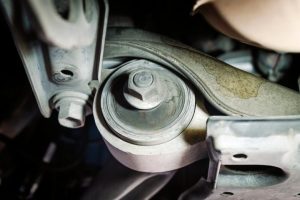
Example of a suspension control-arm bush. Audi uses multiple links and bushes within its multi-link front suspension, with the exact arrangement varying by model
Your Audi’s front suspension is more complex than most owners realise. Rather than a single strut or spring doing all the work, many Audi models use a multi-link layout with several individual control arms on each side. Each one connects the wheel assembly to the vehicle’s subframe and guides how the wheel responds when the road surface changes underneath it.
The upper control arms sit at the top of this arrangement. Their job is to help control where the wheel hub sits and how it moves as the suspension compresses and extends over bumps. It’s a precise system; the arms guide the wheel through a controlled arc so that tyre contact with the road stays consistent.
Where each upper control arm meets the subframe, a bushing isolates vibration and controls movement within the joint. When those bushings are doing their job, the ride feels composed and settled. When they’re not, you start to hear it.
When the Fluid Seal Fails: How Bushing Wear Develops
On certain Audi suspension variants, the upper control arm bushings use a fluid-filled construction rather than solid rubber. Inside each bushing sits a sealed chamber filled with fluid, designed to isolate vibration and improve ride quality. It acts as a built-in cushion between the arm and the subframe, helping to smooth out the constant movement the suspension deals with.
Over time, the seal around that fluid chamber can start to break down. Once it does, the fluid gradually leaks away. Without it, the bushing can no longer control movement the way it was designed to, and the control arm develops play that shouldn’t be there.
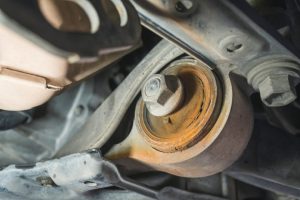
Example of deterioration in a suspension control-arm bush. The design and position of bushes varies between vehicles
That’s what produces the clunking noise. Each time the suspension compresses over a bump or uneven surface, the arm shifts further than it should. It tends to get progressively worse rather than settling down.
What catches owners out is that the rubber on the outside of the bushing can still appear intact. In many cases, the deterioration begins inside the sealed chamber, so the bushing doesn’t show cracks or visible tears.
One of the few external clues is a residue around the bushing mount where fluid has been escaping, but this doesn’t happen in all cases. That’s one of the reasons why a hands-on assessment by an experienced technician is required over a visual inspection alone.
Which 2016+ Audi Models Show This Pattern?
Not every Audi develops this fault, but the fault is recognised across a number of models from 2016 onwards. The following five share a similar multi-link front suspension layout, and they’re the ones where upper control arm bushing wear is reported most widely:
- Audi A4 (2016 onwards)
- Audi A5 (2017 onwards)
- Audi A6 (2018 onwards)
- Audi A7 (2018 onwards)
- Audi Q5 (2017 onwards)
What connects them is a shared upper control arm and bushing design. If you’ve noticed Audi A5 front suspension noise or Audi Q5 suspension clunk, a deteriorating upper control arm bushing is one recognised cause associated with this shared suspension design.
Bushing deterioration can occur on other Audi models too, but these five are the models where it appears most consistently. Whether it shows up as an Audi Q5 suspension clunk or a knock from the front of an A6, the underlying bushing design is a shared characteristic across the range.
How Does This Noise Present Itself Behind the Wheel?
So what does it actually feel like from the driver’s seat?
Audi front end clunking tends to show up as a hollow, percussive knock from the front of the car when you drive over bumps, speed humps, or rough patches of road. On smooth tarmac, nothing; the moment the surface breaks up, the noise comes back. It follows the road surface, not the engine speed or the steering.
If you’ve been searching for Audi A5 front suspension noise or wondering ‘why does my Audi clunk over bumps’, you may be dealing with the same type of upper control arm bushing wear that affects several models across the 2016+ range.
Beyond the noise itself, some owners also notice a subtle change in how the steering responds. The front end may not feel quite as precise as it used to, particularly through corners or over undulating surfaces.
When the bushings have deteriorated enough to develop excess movement, that play introduces unwanted movement in the control arm. Over time, it can affect how the car tracks and turns.
If Audi front end clunking has been bothering you, it’s worth having the front suspension assessed at RS Autotechnik, Dursley sooner rather than later. Worn bushings don’t improve on their own, and continued excess movement can place additional stress on surrounding suspension components.
How the Front Suspension Is Assessed and Put Right
When you bring your Audi to RS Autotechnik, Dursley, the technician starts with a thorough front suspension assessment. Because several components in the front end can produce a similar knock, including anti-roll bar drop links, damper top mounts, and ball joints, each one is checked individually for play, movement, and signs of deterioration.
If the upper control arm bushings are identified as the source of the noise, the technician replaces the complete control arm assembly. Under manufacturer repair procedures, the bushing isn’t a separately serviceable part; the new arm arrives with a new bushing and ball joint already fitted.
With the new arms fitted, the technician then aligns all four wheels to bring the suspension geometry back to manufacturer standards.
If you’ve been putting up with Audi front end clunking or you’re already weighing up Audi A4 control arm bushing replacement, get in touch with RS Autotechnik, Dursley. We’ll walk you through what’s involved and what it costs before anything goes ahead.
Why Choose RS Autotechnik, Dursley for Your Audi?
Knowing what’s causing a noise is the starting point. What matters next is having it assessed and repaired by a team with the right experience and the right approach.
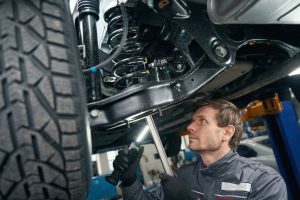
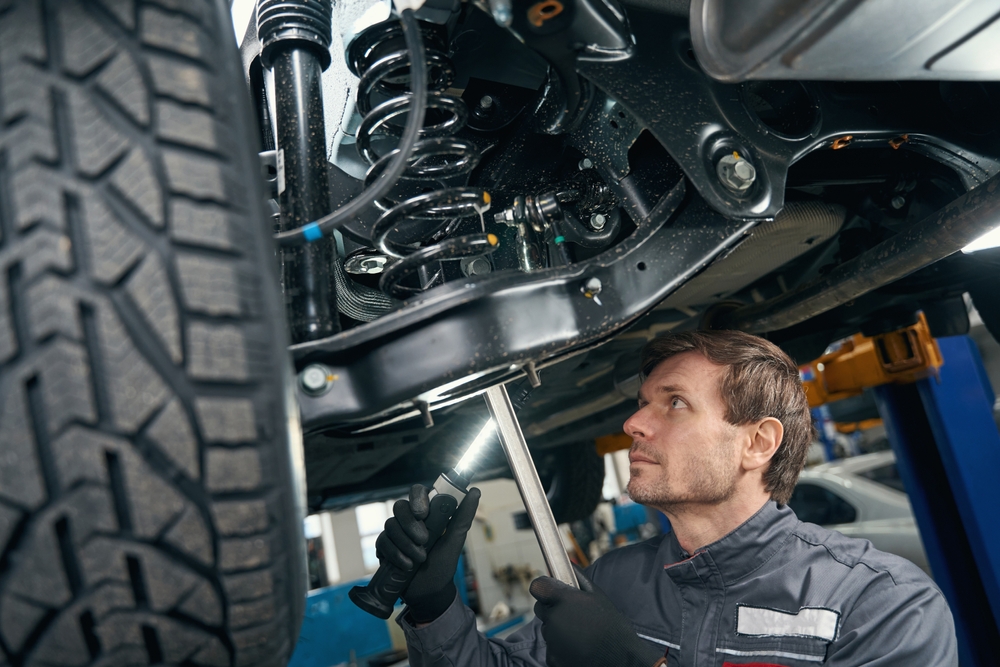
A hands-on suspension inspection can identify wear or movement in bushes, joints and other suspension components
RS Autotechnik, Dursley is trusted by Audi owners across Bristol, Tetbury, and Gloucester for thorough suspension work. Here’s what you can expect:
- Experienced technicians who understand multi-link Audi suspension systems and know where to look
- The correct tooling and equipment to carry out a comprehensive front suspension assessment
- A 12-month parts and labour guarantee on all work completed
- A courtesy car available while your Audi is with us
{{average-rating}} on Google from {{review-count}} Dursley customers, who highlight honest communication and thorough technical work.
If your Audi has developed a knocking or clunking noise from the front end, contact the team at RS Autotechnik, Dursley. We’ll assess the full front suspension and explain what we’ve found and what needs to happen next.
FAQ
Does Audi A4 control arm bushing replacement require a wheel alignment?
A 4-wheel alignment is needed after Audi A4 control arm bushing replacement to bring everything back to manufacturer standards. At RS Autotechnik, the alignment is built into the repair process as standard.
Why does my Audi clunk over bumps?
Several front suspension components can produce a clunking noise over bumps. On many A4, A5, A6, A7 and Q5 models built from 2016 onwards, worn upper control arm bushings are one of the most widely reported sources. A technician at RS Autotechnik can assess the front suspension and confirm the source of the noise.
Can I keep driving with a clunking noise from the front suspension?
Worn suspension bushings allow the control arm to move further than it should, and that excess play can gradually change how the car steers and how evenly the tyres wear. Having the front suspension assessed at RS Autotechnik, Dursley sooner rather than later helps catch the problem before other suspension components are affected.