Mercedes CLS320 Boost Problem
Mr W first noticed something wasn’t right with his Mercedes CLS320 on the way home from work one evening.
The engine had felt a little flat for a few days, but nothing alarming. Then, without any warning, the car lost power in the middle of a dual carriageway. It recovered after a few seconds, but the experience shook him. Over the following weeks, the same thing kept happening, sometimes worse than others, and never at a predictable time.
He took the car to a couple of local garages, but neither could pin down the fault. One cleared the warning lights and sent him on his way. The other suggested it might be the turbo but couldn’t confirm it. Mr W was left with a car he no longer felt confident driving and no closer to understanding the problem.
That’s when he got in touch with RS Autotechnik in Dursley. Our team specialises in complex technical faults on premium vehicles, with access to dealer-level information and equipment that allows us to go further than a standard inspection. Mr W needed answers, and we were confident we could find them.
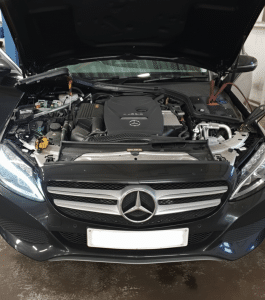
How Was the Mercedes CLS320 Boost Problem Initially Assessed?
When Mr W’s Mercedes CLS320 arrived at RS Autotechnik in Dursley, our first priority was to hear his account of the problem in full. We asked him to describe what the car did when it lost power, how the issue had progressed since he first noticed it, and whether anything seemed to trigger the loss of boost. A clear understanding of the symptoms from the driver’s perspective gives our technicians a direction before any equipment is connected.
With that detail in hand, we ran a full scan using our dealer-level diagnostic equipment. The results were revealing: six stored fault codes, each associated with a separate component within the engine’s boost and emissions systems:
- P2626: DPF soot content too high The diesel particulate filter had logged excessive soot buildup, suggesting the system was not regenerating as expected.
- P2530: Inlet port shutoff motor short to ground A fault with the swirl flap actuator, the part that controls airflow through the intake manifold to support engine efficiency and emissions control.
- P2527: EGR positioner short to ground The exhaust gas recirculation valve was not receiving the voltage required to manage exhaust flow back into the engine.
- P2514: Crankcase ventilation line heater short to ground A heating element in the emissions system had lost its electrical supply.
- P2526: Charge pressure positioner short to ground The turbocharger’s control motor had lost power, which directly affected how the system controlled boost pressure.
- P2376: Throttle valve actuator voltage low The throttle valve, which supports airflow regulation and emissions management, was registering a low voltage signal.
The number of codes was significant, but it was the pattern behind them that caught our technicians’ attention. All six, including Mercedes fault codes P2626 P2530 P2527, related to voltage loss across actuator-driven components. That kind of pattern doesn’t usually mean six separate faults. It points toward a shared cause, and finding it would require careful, targeted investigation.
Tracing the Electrical and Mechanical Causes Behind the Fault Codes
The scan had identified which systems were failing, but the critical question remained: why were they all losing power at the same time? Our technicians approached this by working backwards from the fault codes, tracing the electrical supply to each affected component to find the culprit.
Step 1: Checking the Power Supply
The starting point was to confirm whether the affected components drew power from the same source. Using the Mercedes wiring diagram, our technician mapped the supply for each actuator: the turbocharger’s charge pressure positioner, the EGR valve, the swirl flap actuator, the throttle valve, and the crankcase ventilation line heater.
Each one was fed by a shared fuse supply from the engine’s front control module.
- The fuse was checked and found to be blown.
- With that fuse gone, every component on the circuit would have lost power at the same time, accounting for the cluster of fault codes logged by the system.
A replacement fuse was installed to restore the circuit.
- Several fault codes cleared straight away, which confirmed the first part of the diagnosis was correct.
- However, other codes returned within a short time, indicating something on the circuit was still pulling excessive current.
The problem was confirmed as sitting on that shared circuit. The next step was to inspect each component connected to it.
Step 2: Inspecting the Components on the Circuit
Each actuator and sensor on the shared fuse circuit was examined individually for signs of damage or contamination.
Two problems became apparent during this inspection:
- Oil contamination around the swirl flap actuator The actuator that controls the intake manifold’s swirl flaps was covered in oil. Oil contamination can cause internal electrical shorts or damage the motor inside the actuator.
- Damage to the turbocharger impeller The turbo’s compressor wheel showed clear signs of damage and wear. Oil from the failing turbo had made its way into the intake area, reaching and contaminating nearby components.
These findings brought both sides of the problem together. The oil-contaminated actuator had most likely caused Fuse F44 to blow, while the damaged turbo accounted for the intermittent loss of boost that had been affecting Mr W’s Mercedes.
Step 3: Testing Circuit Stability
With the new fuse fitted and the fault sources identified, the circuit was tested under load to confirm the findings.
- Current draw was measured across each actuator feed to ensure no other component was shorting internally.
- With the swirl flap actuator disconnected, the fuse remained intact, confirming it was the component responsible for the electrical fault.
- The turbocharger actuator, though now receiving voltage, was still not performing correctly due to the mechanical damage already found.
This stage of testing confirmed the link between the electrical and mechanical faults before any new parts were fitted.
Step 4: Planning the Repair
With both root causes verified, the next step was to agree a repair plan that would restore the full system. The shared fuse had already been replaced during the diagnostic evaluation to restore the affected circuit.
The remaining repairs targeted each confirmed fault:
- Replacing the damaged turbocharger to restore boost control and consistent engine performance.
- Replacing the failed swirl flap actuator to clear the electrical fault and prevent the fuse from failing again.
- Repairing the swirl flap mechanism with a new connecting rod and repair kit, which avoided the cost of a full inlet manifold replacement.
- Cleaning the intake area to remove oil residue and keep the new components protected.
With the diagnostic evaluation now complete, we were confident this repair plan would fully resolve the Mercedes CLS320 boost problem.
Completing the Mercedes Turbo Repair
We took Mr W through every finding and explained each repair in detail. With his go-ahead, our technicians started the work: a multi-stage repair addressing both the mechanical and electrical faults uncovered during the diagnosis.
Here’s what was carried out:
- Turbocharger replacement A new OEM turbocharger was fitted, restoring the engine’s ability to control boost pressure and deliver smooth, consistent power.
- Swirl flap actuator replacement The failed unit was replaced, removing the short circuit that had been blowing Fuse F44 and returning full control to the intake system.
- Swirl flap mechanism repair The swirl flap assembly was repaired using a new connecting rod and repair kit. This restored correct flap operation while avoiding the need for a full inlet manifold replacement.
- Intake system clean With the mechanical work complete, the intake area was thoroughly cleaned to remove all remaining oil and protect the new parts from future contamination.
- Circuit stability check With Fuse F44 already replaced during the diagnosis, a final current-draw test was performed to confirm the circuit remained stable and all actuators were functioning correctly.
Every repair element was verified in sequence before the next stage began. This methodical process ensured that the Mercedes turbo repair and all supporting fixes were fully completed and the car was ready to return to the road.
Was the Mercedes Engine Performance Fix Successful?
Once all repairs were in place, the Mercedes CLS320 went through a complete round of post-repair testing. Boost pressure was checked under load, a full fault code re-scan came back clear, and the engine was monitored across a range of operating conditions to verify that nothing from the original problem remained.
Every check came back positive. The Mercedes engine performance fix was confirmed as successful, with no returning codes and stable performance restored.
The Final Result for Mr W
The difference was clear from the first test drive. Mr W’s Mercedes CLS320 was back to delivering the strong, smooth power that had been missing for weeks. Boost pressure was stable on test, and the engine responded exactly as it should. The Mercedes CLS320 boost problem was fully behind him.
It had taken a detailed diagnosis and a multi-stage repair to get there, but by working through each fault in order, our team was able to resolve every issue and return the car to full working condition.
Mr W was very happy with the outcome. After failed visits to other garages, he was particularly impressed that RS Autotechnik traced every fault and completed the repair without needing to replace the full inlet manifold. That decision kept his costs down while still delivering a lasting, high-quality result.
While the work was being carried out, Mr W was able to stay mobile using one of our courtesy cars, keeping disruption to a minimum while his Mercedes was restored to full health.
Mercedes Performance Problems? Trust the Team at RS Autotechnik
If your Mercedes is losing power, feeling sluggish, or showing warning lights on the dashboard, it’s important to have it checked before the problem develops further. These kinds of symptoms can point to connected faults beneath the surface, the same type of issues that caused Mr W’s Mercedes CLS320 boost problem.
Whether you’re in Dursley, Bristol, Tetbury, Gloucester, or the surrounding area, our technicians can help. We used this same structured approach when diagnosing Mercedes boost loss in Mr W’s CLS320, where a detailed technical evaluation revealed and resolved faults across the engine’s boost, emissions, and electrical systems.
Other benefits of choosing RS Autotechnik include:
- Courtesy car to keep you on the road
- 12-month parts and labour guarantee
- Dealer-level knowledge without dealer prices
- Access to the latest Mercedes technical information and repair data
Join the {{review-count}} customers who rate us {{average-rating}} stars on Google. Call 01453 796345 today to book your appointment and get your Mercedes back to its best.