How Does Car Suspension Work?
Somewhere along a back road outside Dursley, your front wheel catches a rough section of tarmac. What follows is a low thud from beneath the car.
You lift your foot off the accelerator. Listen for it again… Nothing comes.
Then, a mile down the road, a raised drain cover passes under the same wheel. The thud returns. Same tone, same place, same weight behind it.
It’s the kind of thing that’s easy to dismiss. But that sound deserves attention, because underneath your car, a suspension component may have started to wear.
And here’s what makes suspension wear different from a flat tyre or a dashboard warning light: it creeps in over weeks, sometimes months, shifting so gradually that you adjust to it without ever noticing the change.
Your car’s suspension connects the wheels to the body and helps control how the vehicle responds to uneven road surfaces, keeping the cabin stable and the tyres in contact with the road. It’s made up of several components, including springs, shock absorbers, control arms, and bushings, each of which wears gradually, which means issues can develop without a sudden warning.
Your car’s suspension uses a combination of springs, shock absorbers, control arms and other components to keep the vehicle stable and the tyres in contact with the road
So, how does car suspension work? What sits beneath the car? What role does each part play, and what goes wrong as those parts age? That’s what this guide sets out to answer.
Each component is covered, the wear patterns that develop over time are explained, and the car suspension problems and symptoms you experience behind the wheel are clearly laid out.
Whether an MOT advisory has prompted the question, something about the car doesn’t feel the way it used to, or you’d like to understand what you’re dealing with before speaking to a garage, this is where to start.
What Does Your Suspension Actually Do?
No road is perfectly flat. Potholes, expansion joints, broken patches of tarmac, and raised ironwork. Every one of those surface changes produces a force that travels upward through the wheel. Without anything in the way, that force would pass straight through into the body of the car and into you.
Suspension fills the gap between your wheels and the vehicle body, and what does car suspension do once it’s there? It handles three jobs at once.
- Road Impact Control. The suspension compresses when a wheel meets a bump, helping to control and reduce the force before it reaches the cabin.
- Tyre Contact. Keeping the tyres pressed against the road surface, even over uneven ground, so braking and steering remain effective.
- Stability. Controlling how much the body rolls through corners, dips under braking, or squats during acceleration.
When all of that works as it should, you don’t think about it. The ride feels settled, the steering responds cleanly, and the car tracks straight.
When components begin to wear, the system can’t handle those three jobs as effectively. That’s when you start to feel it from behind the wheel.
Springs and Shock Absorbers: Where the Heavy Work Happens
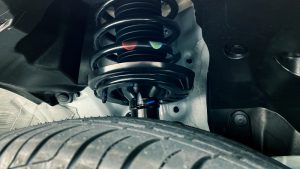
Coil springs compress as the wheels travel over uneven surfaces, helping absorb road impacts before they reach the cabin
Two components bear more of the load than any others in the system, and neither one functions as it should without the other.
Coil Springs:
The vast majority of modern cars carry coil springs at each corner. When a wheel meets a ridge, a pothole edge, or any change in surface height, the spring is the first thing to react. It compresses under the incoming force to help control and reduce the initial impact, then extends to push the wheel back to where it started.
Everything that happens after that initial compression falls to the shock absorber.
However, coil springs don’t last forever. Wear sets in over tens of thousands of miles. They can sag and lose height, they can develop hairline cracks, or… snap altogether.
When a spring sags, one corner of the car drops lower than the others, something you’ll spot when the car is parked on level ground. A fractured or broken spring is a recognised MOT failure point.
So what stops your car from bouncing after every bump? That’s the shock absorber’s job.
Shock Absorbers (Dampers):
After a spring compresses and rebounds, the shock absorber controls what happens next. Inside, oil is channelled through internal valves as the suspension moves, resisting the flow and settling the motion. Without that resistance, the spring would keep bouncing. With it, the car returns to a composed ride within a stroke or two.
Once dampers deteriorate, the effects show up clearly: the body sways on straight roads, it rolls further into corners, and the front of the car drops more noticeably when you apply the brakes.
MacPherson Struts:
Rather than mounting the spring and damper separately, many manufacturers combine them into one unit. A MacPherson strut positions the shock absorber at the centre of the assembly, with the coil spring seated around the outer casing.
It’s a layout found widely across modern front-wheel-drive models, and because the strut also serves as part of the steering and suspension geometry, it does more than just absorb bumps. Any work needed on this type of setup means addressing the strut assembly as a complete unit.
Other configurations exist. Double-wishbone and multi-link arrangements, more prevalent on premium and performance models, position the spring and damper as two independent components. The physics remain the same. Only the packaging differs.
If the car bounces more than you remember, rides less confidently over uneven ground, or pitches forward when you brake, these components are the first place to look.
Our technicians at RS Autotechnik, Dursley, can check the condition of these components and let you know what needs attention.
Control Arms, Bushings, and Anti-Roll Bars: Keeping the Wheels Where They Should Be
Vertical force is only half the challenge. While springs and shocks govern how the wheel travels up and down, every wheel also needs to stay pointed in the right direction throughout that movement. That’s where this group of components comes in.
Control Arms:
Without something anchoring the wheel assembly to the body of the car, it would have no reference point. Control arms provide that anchor.
These metal links bridge the gap between each wheel’s hub assembly and the vehicle’s chassis or subframe, allowing upward and downward travel over bumps while maintaining the wheel’s position and alignment. Ball joints and bushings sit at each end, and when either wears past a certain point, wheel geometry drifts.
The result is felt through the steering, through inconsistent braking behaviour, and through uneven tyre wear patterns.
Bushings:
Every pivot point in the suspension relies on a rubber bushing. Sitting between metal surfaces at each connection, these components do three things: they soak up vibrations that would otherwise transfer into the cabin, they dampen road noise at source, and they allow each joint the precise range of movement the suspension geometry demands.
Once the rubber degrades, a hollow knocking sound develops when driving over bumps in the road, particularly at lower speeds. Steering precision drops, and the car may pull to one side, though pulling can also stem from tyre pressures, alignment, or brakes.
Anti-Roll Bars and Drop Links:
Cornering forces push the car’s weight to the outside of a bend. Without resistance, the body would lean heavily. An anti-roll bar counters this by spanning the full width of the vehicle, linking the left and right suspension together. When one side compresses in a corner, the bar transfers a portion of that force to the opposite side, reducing the lean.
The bar connects to each side of the suspension through drop links, which are a recognised wear item and a well-documented MOT advisory point.
Rattling or knocking noises over uneven surfaces can point to a worn drop link. Where excessive play is found in ball joints, or a deteriorated dust cover is no longer preventing dirt from entering the joint, the outcome is either an MOT advisory or a failure, depending on severity.
Knocking sounds, tyre wear that’s uneven across an axle, or a car that doesn’t respond the way it once did could all trace back to components in this part of the system.
Call RS Autotechnik on 01453 796345, and we’ll talk you through what to do next.
Air Suspension: A Different Approach, with Its Own Failure Patterns
Not every vehicle rides on coil springs. Some premium models replace them with airbags, air-filled units at each corner that inflate and deflate to carry the vehicle’s weight and set the ride height. Shock absorbers still handle the damping, just as they would on a conventional system.
What sets air suspension apart is its ability to adjust. Height can change automatically in response to speed, road surface conditions, or a setting chosen by the driver. A compressor feeds pressurised air into the bags, and electronic controls independently manage the pressure at each corner, keeping the vehicle level regardless of load or terrain.
The clearest signal that something has gone wrong is one you can see: the car sitting lower on one corner, or sinking down after being parked overnight or left standing for a period. That visual clue points toward a leaking airbag or a fault with the valve block that manages airflow between corners.
Once an airbag develops a leak, the compressor has to run more often to try to compensate. Over time, that extra load accelerates wear on the compressor itself, meaning one fault gradually creates a second.
Addressing air suspension issues requires the right knowledge and equipment. Each system is electronically controlled, the parts are vehicle-specific, and tracing the source of a slow leak takes experience alongside correct tooling.
It’s a job worth putting in front of someone who genuinely understands these systems.
Recognising Worn Suspension: Six Signs Worth Acting On
Wear doesn’t announce itself with a single dramatic event. It accumulates beneath the car while you drive, and because you’re behind the wheel every day, the gradual shift in how the car feels goes unnoticed until it becomes significant.
Catching the signs of worn suspension early is the key to addressing problems before they develop further.
What does worn suspension feel like in practice? Six things to pay attention to.
- Clunking or Knocking Over Bumps. A hollow thud or metallic knock each time a wheel crosses a speed bump, drops into a pothole, or the car turns at low speed. The source could be worn bushings, a deteriorating drop link, a fatigued spring, or another component within the system.
- Pulling to One Side. Without any input through the steering wheel, the car drifts left or right. Worn control arms, degraded bushings, or shifted wheel geometry are among the potential causes, though other factors including tyre pressures and brake condition may also contribute.
- Uneven Tyre Wear. Wear concentrated on one edge of the tread, or a mismatch in wear rates across the same axle. Both patterns suggest that wheel geometry has shifted, something suspension deterioration can trigger.
- Car Sitting Lower on One Corner. A visible lean when the vehicle is standing on flat ground. A sagging or fractured coil spring is one explanation; on vehicles fitted with air suspension, a leaking airbag is another.
- Excessive Body Roll. The body tilts further than expected through bends and the car feels less planted at speed. Worn anti-roll bar components, worn shocks, or accumulated wear across several parts of the system may all play a part.
- Front End Dips Under Braking. The nose of the car drops more sharply than you’d expect when you press the brake pedal. The suspension isn’t managing the forward weight transfer effectively, and worn shock absorbers are one possible cause.
These car suspension problems and symptoms don’t exist in isolation. Several components can produce overlapping sensations from the driver’s seat, and diagnosing the source without assessing the full system leads to guesswork. It’s worth having everything checked by someone experienced.
Get in touch with RS Autotechnik, Dursley, and we can check it over for you.
Suspension and the MOT: What Gets Assessed
Every MOT includes an assessment of the suspension system. The test is a legal requirement for all vehicles over three years old in the UK, and suspension components that have deteriorated beyond an acceptable threshold will be recorded as an advisory or a failure.
Among the items inspected are ball joints, springs, gaiters, bushings, drop links, and shock absorbers. Each component is assessed on its own merits, and where wear or damage has progressed far enough to compromise safety or roadworthiness, it’s flagged.
Worth remembering: the MOT represents a minimum legal standard. It captures a snapshot of the vehicle’s condition on the day of the test, nothing more.
If your vehicle has collected suspension advisories, a natural question follows: how long does car suspension last before it becomes a problem?
The answer varies by component, by vehicle, and by the kind of roads you drive on. Having any flagged items assessed before your next test is a more practical approach than waiting to see what happens.
Why an Expert Assessment Makes the Difference
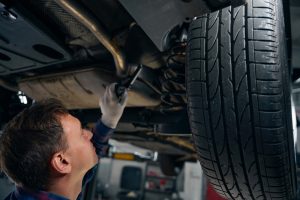
A thorough suspension assessment helps pinpoint worn components and identify the cause of knocking, pulling or changes in handling
Multiple suspension components generate symptoms that feel the same from the driver’s seat. A clunk when you hit a bump could originate from a worn bushing, a failing drop link, or a cracked spring. A pull to one side might be caused by a control arm, a degraded bushing, or something that has nothing to do with the suspension at all.
Getting to the right answer before ordering parts is what separates a good repair from a wasted one. Fit the wrong component and the bill goes up, the problem stays, and the car goes back on the ramp.
An experienced garage takes a system-level view. Rather than treating a single component in isolation, the assessment considers how the parts interact, maps where the wear sits, and arrives at a clear picture before recommending anything.
Findings are explained before work starts, so you’re making decisions based on what’s actually been found.
Now that “how does car suspension work?” has been answered and you understand what each part does and what wears out, you’re in a more informed position the next time you speak to a garage.
You’ll know what questions to ask, and you’ll understand the answers.
Why Choose RS Autotechnik, Dursley, for Your Suspension?
Knowing how does car suspension work puts you in a position to spot problems earlier and have a more informed conversation with a technician. The logical next step is finding somewhere equipped to assess the full system and get everything right first time.
Wear builds gradually beneath the car. Caught early, issues can be addressed before they deteriorate further, affect neighbouring components, or result in an MOT failure.
At RS Autotechnik, Dursley, our technicians have the experience and equipment to thoroughly assess your suspension system, identify what’s worn, and carry out all repairs to the required standard.
- Expert technicians working on your vehicle.
- A 12-month parts-and-labour guarantee on all repairs carried out.
- A courtesy car available while your vehicle is with us.
Join {{review-count}} local Dursley drivers who’ve rated us {{average-rating}} on Google, with reviews highlighting accurate repairs, expert advice, and excellent value.
Whether you’ve noticed a strange noise, had an MOT failure or advisory, or just want peace of mind, call RS Autotechnik, Dursley on 01453 796345, and book an expert suspension inspection.
Our team will assess your car’s suspension system and let you know where things stand.
Frequently Asked Questions
How does car suspension work?
Suspension sits between the wheels and the vehicle body, managing every force that the road surface sends upward. Springs react first, compressing to absorb the initial impact, and shock absorbers govern what follows by resisting the spring’s rebound through calibrated oil flow inside the damper unit. Control arms anchor each wheel to the chassis while permitting vertical travel, bushings cushion the connection points, and anti-roll bars limit lean through corners. Working together, these components keep the cabin stable, the tyres gripping the tarmac, and the car predictable under braking, steering, and acceleration.
What does car suspension do?
Three things happen simultaneously. Road surface impacts are reduced before they reach the cabin, tyre contact with the tarmac is maintained so that braking and steering remain effective, and the shifts in weight that occur through corners, under braking, and during acceleration are controlled. Strip away the suspension and every pothole, joint, and rough patch would travel unchecked from wheel to body to driver.
What are the signs of worn suspension?
Knocking or clunking noises when you drive over bumps and potholes, the car drifting to one side without steering input, uneven tread wear across a tyre or axle, a visible lean when parked on level ground, the body rolling excessively through corners, and the front end dropping sharply under braking all point toward suspension wear. Because more than one component can generate the same sensation from the driver’s seat, a full assessment by an experienced technician is the most effective way to identify the source.
How long does car suspension last?
Component lifespan varies with driving conditions, annual mileage, road quality, and the specific part in question. Coil springs on well-maintained roads can remain serviceable for many years, while bushings and drop links tend to wear sooner because they’re in constant motion and exposed to road debris. Shock absorber performance declines incrementally rather than failing outright. No universal replacement interval exists, which makes periodic assessment valuable, particularly once symptoms have started to appear or MOT advisories have been recorded.
Can worn suspension cause an MOT failure?
Suspension wear leads to both advisory notes and failures during the MOT. Ball joints, springs, shock absorbers, bushings, drop links, and gaiters are all inspected, and where deterioration has reached a level that compromises safety or roadworthiness, the result is recorded. Having advisories assessed and addressed between tests is the most practical way to avoid a failure next time around.